%%USERNAME%%    %%ACCWORDS%% %%ONOFF%% |


 The FSFS Newsletter is written by FSFS members covering everything Fantasy and Sci-Fi |
The "Fantasy and Science Fiction Society" welcomes you to  Welcome to the March edition of the Newsletter. Written by members of the "Fantasy and Science Fiction Society" for all of Writing.Com, this month we are focusing on editing to celebrate National Novel Editing Month. Contents 1. Introduction 2. Poems and Editing 3. So You Wrote a Novel! Now What? 4. Writing is a Business 5. Book Review: The Mirror of Her Dreams 6. Advertisements 7. Vote  Big news everyone! The FSFS logo is changing. A E Willcox   , who designed the original logo, has created a stunning new image for the front of our growing group. To celebrate the new logo, check out the video she created to show it off! , who designed the original logo, has created a stunning new image for the front of our growing group. To celebrate the new logo, check out the video she created to show it off!To say a big thank you to Amanda for creating such a wonderful image, head over to her raffle:
In other exciting news, the FSFS now has writing critique groups. A WCG is a small group of no more than 5 members where you can work together to improve your story. The survey form is out and over the next week or so the first lot of groups will be assigned. If you are an FSFS member and want to participate go to "Invalid Item" for more information.  As a new writer, of poems or stories, you might wonder if poems need editing at all. After all, aren’t poems words of emotions painted onto the page from the writer for us to try and glean what they were feeling at the time? Or perhaps we want to catch a glimpse of their emotions, or try and remember a time when we felt the same as well. As many here at WDC know poetry has many forms of presenting itself to us and even in their vast and varied forms the art itself can be subjective to the reader. But as a writer of both poems and stories I can tell you editing is important to both and the biggest purpose of editing is to become a better writer. With poems, however, it can be far more subtle. Many times it depends upon the length and type of poem you’re working on. You must first consider if the poem is a particular style – does it have rules it must follow? Such as a Sonnet, Limerick, Briolette, Diamante, Tanka or Rondeau? All the previously mentioned poems have their own specific rules as to stanzas, rhythm, rhyme, meter and sometimes tone. As such, once you’ve written a poem in a specific style, editing should be a crucial step to be sure you’ve stayed within the context of these rules without losing the meaning of your poem. For me? I have a habit of writing in free verse. This means I have far more luxury in how I write my poetry. But my poetry must still have a flow and rhythm to it which does not cause the reader to “stutter” in their reading of it. The basic rule I try to adhere to is consistency. If I do one thing in my poem, then it must be done throughout the poem. For example – rhyming, stanza length, perhaps a specific phrase for emphasis As I mentioned before, I know many of us poets are think it, write it, before we forget it types. I’ll be the first to admit I’m one of those types. Many of my better poems have come out of my pure emotions of the moment. When I’m asked to do a poem from a prompt – sometimes it can take a few days (or weeks) for me to come up with something which fits the prompt appropriately. For example, the last two stanzas of …… No Escape Plan, © By: Lisa M. Gordier; June 26, 2015 Light has fled this place No morning, day or dusk Only blackest midnight Now reigns here No moon lights a path Nor torch a hall Death walks boldly No escape plan As you can see in these last two stanzas there is just the intended meaning. However, as I look at the last line even I’m realizing it could be better because there’s no real clues as to whom as “no escape plan”. Is it “death” wandering the hall or would it me myself? So it occurs to me I’ll most likely want to change either the last verse, last stanza or even put in another stanza. I could even go back through all previous stanzas to correct little things to perhaps make the complete poem a better one as a whole. The last example I’d like to show you is a poem I’m currently working on. I’d like to show you the different thinking process I go through when writing with pure emotion and an almost “write it – leave it” sort of attitude vs. a “write & consider” aspect for poetry. This piece I had a concept, an idea of how I felt at the moment but now words to put to it yet. You might say I was acting upon a prompt issued idea and had to make the words for it later. The prompt? “Tired and Tormented”. I’m sure many of you could come up with something to go with that title but, as mentioned, I was looking for the specific emotional reasons I was feeling this way. My last example: First & Third Stanzas of...Tired and Tormented, © By: Lisa M. Gordier (unfinished) I am tired and tormented Sailing a becalmed sea Canvas has not moved So many years past Provisions have long since run dry Third Stanza……. I cannot live upon a ship Where canvas is not stirred By gusty summer winds With clouds hot upon their heels Shade a vacant memory to weary eyes As you can see, I’ve used my “Prompt” as my title to give not just my poem an image but myself an image of what I want to work with. When I did the first draft of this poem I did not have the single lines after the stanzas. They were not put in until after my third edit of this particular poem. Also, in the second edit I noticed I had certain words “flipped” into wrong places or used wrong and hand to change them. I’d like to close with reminding everyone we’re all not perfect editors on our own. We can each stare at a particular piece, whether poem or story, and think we’ve caught everything (or nearly so). There are a few things to remember which might help with the editing process. • Dictionaries, Thesauruses, Encyclopedia, Libraries and the Internet can be our best friend. o Don’t be afraid to use them if you’re either stuck or need to look up words. • Don’t be afraid to ask someone to look at your work and review it for either readability and/or errors. o That someone can be…here on WDC, a friend, relative, co-worker – whomever you want so you can see how your writing is progressing. • Don’t be afraid of constructive criticism. o After you’ve asked someone to review your work, the most important thing is to ALWAYS KEEP AN OPEN MIND. o Never be offended by what others THINK of your writing. Remember it’s an OPINION and still your work. You have the right to not change it. o Constructive criticism is your best friend when editing your work. It will help you focus on portions of your writing you may need improvement upon. Take advantage of the many forums, authors and writers who are a part of WDC. Many will stop by your port to check out your writing and give you reviews. Take them to heart and consider their words with the love they are intend as and perhaps venture forth on your own and review/edit someone else’s writing to help them in their quest to become better writers as well. "Invalid Item" by A Guest Visitor  ** Image ID #1804508 Unavailable ** Yes, you really did write a novel, but let's face it, what you have is a rough, first draft. The creative conception of your novel is a done deal, but your book is far from ready to publish. ** Image ID #1997591 Unavailable ** Now it's time to let your inner editor back out of its cage and put it back to work. Now is when you get down to the nitty-gritty of rewrites, proofreading, and editing, all of which must be accomplished before you can even think about getting your masterpiece ready to submit to a publisher for consideration. Let's talk about some of the tools you'll need to begin taking your novel to the next stage. Your Next Steps ** Image ID #1889674 Unavailable ** Your first draft is the block of marble from which your final product will be carved. Michelangelo is said to have been asked how it was possible to find something as grand as "The Madonna" in a raw block of granite. His reply was, “Simple. You just carve away everything that does not look like The Madonna.” We urge you to remember these words, carve them on your heart and in your mind. Then learn to see your writing with the eyes of a master artist. The early draft of your work is the rough, chopped lump of marble. When you finish your first draft, you’ve done nothing more than create the rough lump of granite from which your final masterpiece will emerge. Now, you must chip at it, and sand it, and polish it, until it shines like the brilliant star you imagined in the beginning. Every good writer learns and understands that there are many steps in the process of writing a novel before one achieves a Masterpiece. If you haven’t already discovered your own style and method for proofreading and editing now is the best time to get started doing so. Proofreading Your Work ** Image ID #1889519 Unavailable ** Can you read this? Take a few minutes and try. I think you’ll be surprised. It really isn’t all that hard. i cdnuolt blveiee taht I cluod aulaclty uesdnatnrd waht I was rdanieg. The phaonmneal pweor of the hmuan mnid, aoccdrnig to a rscheearch at Cmabrigde Uinervtisy, it dseno't mtaetr in waht oerdr the ltteres in a wrod are, the olny iproamtnt tihng is taht the frsit and lsat ltteer be in the rghit pclae. The rset can be a taotl mses and you can sitll raed it whotuit a pboerlm. Tihs is bcuseae the huamn mnid deos not raed ervey lteter by istlef, but the wrod as a wlohe. Azanmig huh? yaeh and I awlyas tghuhot slpeling was ipmorantt!1 It is amazing how the human brain works. Unfortunately, the very capacity that enables you to read the above piece of mish-mash is your enemy when it comes to proofreading, especially so when proofreading your own work. You know what you’ve written, and your mind has a tendency to skip over many basic spelling and punctuation errors. The first thing you should always do is run your computer’s spell check and grammar check programs. They will target many of your errors. But, your computer program does not know every accepted spelling, nor all accepted meanings for every word in the English language, so you can’t stop there. Grab a good dictionary and double check every word you thought was spelled and/or used right that your computer flagged. Next go through your piece, chapter by chapter, and really look at each and every individual word to make sure you have the correct spelling for the meaning you are using in that context. One of the easier ways to do this, without allowing your brain to skip ahead, and miss things is to start at the end and go through each chapter backward, from ending to beginning. Because the sentences don’t make sense backward your brain and your eye will be less likely to slip ahead. You will be more likely to spot sneaky little spelling boo-boos waiting to ambush you and embarrass you in front of your editor or publisher. This step covers your spelling and most punctuation errors. Next, you need to go back and read each of your chapters for grammatical errors and plot inconsistencies. Don’t just sit and read them to yourself. As in spelling, here too your brain will have a tendency to skip forward and fill in the things you know you meant to put in there—even when they are missing! Go somewhere where you won’t bother anyone or be interrupted. Take the time to read each chapter out loud. Again go slow and read your piece word for word as it is on paper—not how you intended it to be—but exactly as it is written down. You will be surprised at how many things you missed when you checked for spelling or sat and read the piece silently to yourself. Now ask someone else to read your chapters out loud to you. Don’t interrupt them, but as they read make notes on any errors you hear. Repeat the above steps as many times as needed, until you are sure you found all of the problem areas. Just proofreading isn’t enough to bring your work to that final point of perfection. Once the proofreading is done you must go back and correct the errors, remove the inconsistencies, reweave the weak areas, and trim away all un-needed extraneous material that does not move your story forward. Avoiding Wordiness ** Image ID #1889523 Unavailable ** Wordiness is a common problem for prose writers. It's important not to "clog up" your prose with extra words, phrases, or paragraphs that aren’t necessary to move your story forward. Following is a list of methods you can use to eliminate wordiness in your writing. ♥ Convert word groups or phrases to single words whenever possible. ♥ Convert modifying clauses into phrases or single words whenever possible. ♥ Use expletives sparingly, if at all. ♥ Use active instead of passive verbs. ♥ Avoid using too many noun forms of verbs. ♥ Write infinitive phrases as finite verbs or brief noun phrases ♥ Eliminate circumlocutions with direct phrases. For example: change At this point in time to Now. ♥ Omit words which state the obvious, or provide excessive detail. Remember: If a second grader can understand it, you have explained it. ♥ Omit repetitive wording. Making your writing crisp, precise, and concise will move your story forward at a steady pace and help keep your reader engaged. Rewriting and Editing ** Image ID #1889525 Unavailable ** There are a number of different ways to go about the rewriting and editing process. Let me warn you here—none of them are easy. Rewriting and editing is time intensive, hard work. It doesn’t really matter which method you use as long as you buckle down and do the work. Take the notes you made during the times the piece was read out loud. Then go through the entire novel line by line, paragraph by paragraph, chapter by chapter. Rewrite every single poorly formed sentence, every paragraph that isn’t clear, and every action that does not move your plot forward. Eliminate anything that is not absolutely necessary to tell the story in a clear and concise manner. Do this over and over until you feel you have each chapter as close to perfect as you can get it. There are numerous writing resource books on the market that explore proofreading as well as editing and polishing. You should have at least two different resource books in your personal writing reference library in addition to your dictionary and thesaurus: one on writing style and basic grammar, and one on rewriting and editing. There is a list of my favorites in the Printed Resources section at the end of this article. Check them out and then go find those that suit you the best. One last thought . . . ** Image ID #1889527 Unavailable ** As writers we all have a tendency to become attached to our precious written words. For proper editing and rewriting you cannot cling to them. I had an instructor once who said, “Until you are ready to ‘murder your darlings’ you will never be a good writer.” So I repeat here if you want to do a good rewrite and reach perfection you must “Murder your darlings!” But never worry! Even better words and phrases will rise up and live to take their place – if you work hard! Now pull out those reference books. Get out that red pen. Warm up your DELETE key. It’s time to go to work – line by line, page by page, and chapter by chapter! ** Image ID #1883399 Unavailable ** Resources Online ♥ The Owl at Perdue – Free Writing Help and Teaching Resources http://owl.english.purdue.edu/owl/ ♥ Fiction Factor – Honing Skills http://www.fictionfactor.com/honing.html ♥ Painful Prose: How to Edit Your Paragraphs to Make Them Great http://www.associatedcontent.com/article/40751/painful_prose_how_to_edit_your_pa... Resources In Print ♥ Write Right – A Desktop Digest of Punctuation, Grammar and Style by Jan Venolia Publisher: Ten Speed Press Berkeley ♦ Toronto Date: 2001 http://www.barnesandnoble.com/w/write-right-jan-venolia/1111609915?ean=978158008... ♥ The Elements of Expression by Arthur Plotnik Publisher: Henry Holt and Company New York, New York Date: 1996 http://www.barnesandnoble.com/w/the-elements-of-expression-arthur-plotnik/111079... ♥ ReWrite Right – Your Guide to Perfectly Polished Prose by Jan Venolia Publisher: Ten Speed Press Berkeley ♦ Toronto Date: 2000 http://www.barnesandnoble.com/w/rewrite-right-jan-venolia/1004089614?ean=9780307... ♥ Getting the Words Right How to Rewrite, Edit & Revise by Theodore A. Rees Cheney Publisher: Writer’s Digest Books Cincinnati, Ohio Date: 1990 http://www.barnesandnoble.com/w/getting-the-words-right-cheney/1014356778?ean=97... New and used copies of all the above books listed in this Resource Guide are available on Amazon.com, BarnesandNoble.com, and/or Alibris.com. "Invalid Item" by A Guest Visitor  So, here’s what I learned about five years ago, writing is a business. I’d dreamed of getting my science fiction and fantasy stories published since I was a teenager. But I didn’t exactly understand what they meant other than write, write, edit, write, proof, and repeat as needed (which was a hard lesson for me to learn). I went to my first science fiction convention at what had to have been one of the lowest points in my life, except for the fact that I was writing and posting on Writing.com and the reviews – were positively helpful. At that first convention best-selling authors Kevin J. Anderson and his wife Rebecca Moesta were the guest authors of honor. I went to their presentations on the truths of publishing. Warning included never give up your day job, because you will not get rich writing, and paperback book are sold on consignment and since book stores don’t want to pay to mail them back to the publishers, the covers are torn off and the unsold books are destroyed. I bought one of Kevin’s books in the Dealers Room at that convention, he autographed it and we chatted. He told me about his business of being a science fiction and fantasy writer seminar, coming up a few months later. That weekend my life changed, you see, I’d been out of work for months – and had a job interview, which led to the day job I’ve had ever since. I also went to that seminar. It’s been five years since I went to that seminar and four years since I signed my first contract for a novel (with a small press). So, it was about time I went again – I’ve just returned from five days in Colorado Spring at the Superstars Writing Seminar. There were one hundred and twenty-five of us, including the “faculty,” in addition to Kevin and Rebecca, including Jim Butcher, Dave Farland, Eric Flint, Jody Lynne Nye, James A. Owen, and a number of editors, who talked about their side of the business, what they look for, what they hope for, why they often reject stories. Other issues discussed were how to read a contract (and what changes you will need to make before ever signing one), optioning your book in Hollywood (and why that may not be in your interest – or could help you sell a million books), how to launch of book and do book signings, and more. But the seminar is also about networking and helping each other, which you don’t always find when going to a convention or being part of a writer’s group, where the craft of writing can get lost because we as the writers don’t understand or listen. For example, one of my colleagues who has written fan fic recently completed his first novel and wrote a quarter million words. He knew that was too many words and lamented that he was going to have to cut a lot of the story. I asked him if he loved every word. The question surprised him. I asked him if he could cut the novel into thirds or in half. He’s immediate response was he couldn’t cut it in thirds and he definitely couldn’t cut it in half… then his eyes widened. “Um, in half? Maybe.” Then he figured it out. Now he’s two novels that took him eighteen months to produce and all he had to do was think about it differently. I met a winner of the L. Ron Hubbard Writers of the Future Contest. I asked him how many years he had entered before he won. He told me only twenty-five. He had lots of finalist and Honorable Mentions (all of which meant he had written professional level stories that the contest editor read all the way through -- and the finalist ones were exceptional) and had sold some short stories, but all the magazines and anthologies folded before publishing them. He stopped writing due to the rejections he started to receive after that. He kept getting personal notes from the editors rejecting those stories, telling him how much they liked them, but they weren’t what they were looking for. He didn’t understand that those rejections were telling him just how great those stories were. I understood just what he was saying, right before I stopped submitting stories for about fifteen years, I received a personal note on a rejection letter and never thought of it as something special. I believed in that story, which became part of my first published novel, part of the series that earned me my place in SFWA (Science Fiction Writers of America), my benchmark for becoming a professional writing. I guess what I am trying to say here is we’re not in this alone – and sometimes you have to dare to take a chance (as a writer or something else you’re aspiring to). It won’t be easy. It will be discouraging, but perhaps not as discouraging as you think, not if you work on understanding how the business work or on asking others what they think… and truly listening to what their experience may have to offer. "Writing is a Business " by Highmage - D.H. Aire  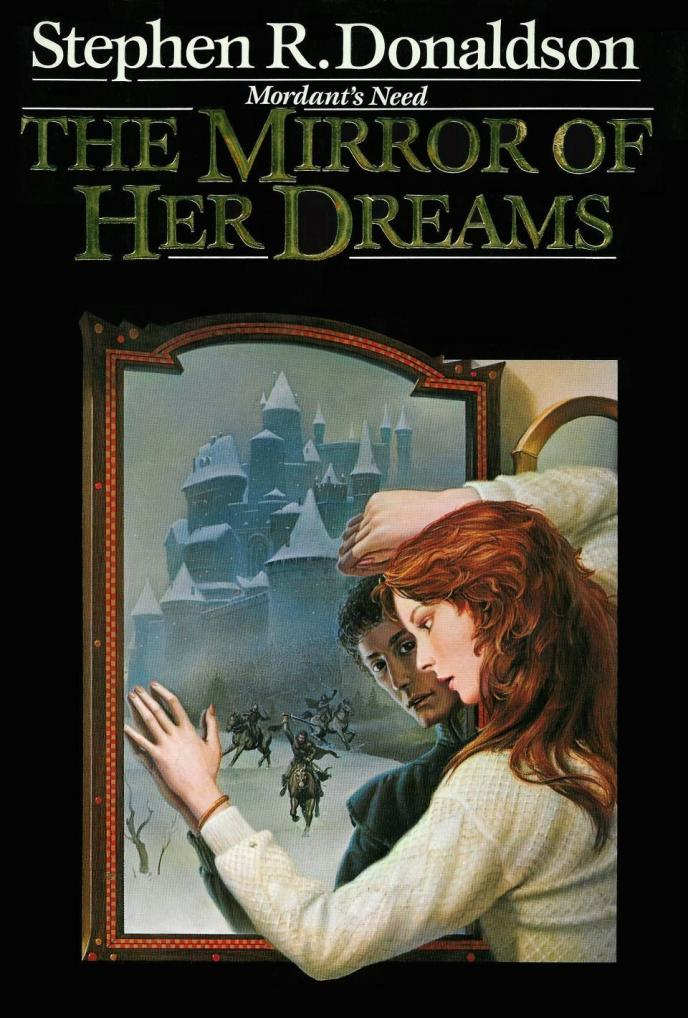 Book Name: The Mirror of Her Dreams Author: Stephan R. Donaldson First Published: 1986 Stephen R. Donaldson was born in 1947. He spent much of his youth in India due to his father’s work as an orthopedic surgeon in that country. He attended the Kodaikanal International School. Later, he would gain a bachelor’s degree from The College of Wooster and a Master’s from Kent State. He currently lives in New Mexico. Donaldson is best known for his long-running series The Chronicles of Thomas Covenant, a fantasy about a man who suffered from leprosy and was called to an alternate world to save it. His stories are characterized by a sense of moral bleakness, complex psychological reasoning, and a fondness for arcane vocabulary. Mordant’s Need is a two-part series, a long novel that was broken up into two parts, and features a unique magic system and court intrigue that rivals the “Game of Thrones”. The author’s stories show a wide range of influences, such as the operas of Richard Wagner, Mervyn Peake, C.S. Lewis and JRR Tolkien. The largest inspiration for The Mirror of Her Dreams must come from Roger Zelazny’s Amber novels, of which the author is known to be a big fan. “The story of Terisa and Geraden began very much like a fable. She was a princess in a high tower. He was a hero come to rescue her. She was the only daughter of wealth and power. He was the seventh son of the lord of the seventh Care. She was beautiful from the auburn hair that crowned her head to the tips of her white toes. He was handsome and courageous. She was held prisoner by enchantment. He was a fearless breaker of enchantments. As in all the fables, they were made for each other.” ― Stephen R. Donaldson, The Mirror of Her Dreams The Mirror of Her Dreams is the story of Terisa Morgan, a young woman that feels as if she is fading from existence and has doubts that she is real. To help her establish her own reality, she lines all the walls of her apartment with mirrors. By seeing her reflection, she assures herself that she is alive. One night, Terisa has a dream where she is hounded by men on horseback. A young man steps in to protect her. The following night, she has a bout of fear that she is fading from the world. To counter this, she sits in front of one of her many mirrors. That is when the man from her dream crashes through the mirror before her. He is Geraden, a bumbling Apt who has failed to become an “Imager” after ten years of study. He comes from a mystical world called Mordant and is in search of a champion to save it. Geraden is convinced that Terisa is that champion, even though the girl is not quite what he was expecting to find. He pleads with her to come with him through the mirror to Mordant and Castle Orison. Starting as an ordinary shy girl from New York City, Terisa transforms into the center of palace intrigue. The court of Mordant is divided about her. Some believe she is a powerful “Imager” because she was discovered in a room of mirrors and could see her own reflection without going mad. They view Terisa as a potential ally or threat. In Mordant, magic comes from mirrors. The mirrors show only one place and time and no one sees their reflection in them. The powerful “Imagers” use the magical mirrors to see into the future or parallel worlds. The other half of the court is convinced that she is just another mistake of Geraden’s and do not take her seriously. Terisa must deal with the puppy-dog earnest Geraden, a senile King and his strong-willed daughters, a mad Adept, Geraden’s well-meaning brothers, and the factions of Imager masters that belong to guild known as the “Congery”. The threads of the story twists and turns and little is what it appears in Orison. There is a plot to depose the King, a rogue Imager sends magical creatures to cause destruction in the kingdom. It all is overwhelming to a doubting Terisa who can hardly make a decision of her own due to her debilitating passivity. Can she overcome her inner fears and become the champion of Mordant as her friend Geraden remains firmly convinced? ### I first read The Mirror of Her Dreams when it first came out in 1986. I blush to say it, but the striking cover of the girl looking into a mirror and a man gazing back at her from the glass caught my eye and intrigued me. I had read Donaldson’s The Chronicles of Thomas Covenant books and was pleased to see that he had branched out into a new world. What struck me first about the book was the unusual heroine, a girl that had been abused by her parents that she was passive enough that it could endanger her, even in our own world much less that of a fantasy realm. I found myself having sympathy for Terisa Morgan, although there were times when I wanted to shake her and tell her to wake up. Women today may have trouble with the passivity of this heroine for she is not a strong female and does tend to lean on the men around her. The first half of the book does drag due to the long information dumps about Mordant’s past and world building description. I feel that the author might have found another way to convey this information. However, the court intrigues, the constant danger that Trisa and Geraden find themselves in did keep the story interesting enough for me to finish the book and then go on to its sequel. I also enjoyed the mild romance between these two characters. Where the book shines is in the details of the Imagers and their guild the Congery. The magic system is rather unique, but has a strong basis in previous fantasies, with hints leaning toward Carroll’s Alice in Wonderland or Zelaney’s Prince Corwin of Amber. There is much to like about this fantasy novel and its sequel, A Man Rides Through. While the first novel is a bit slow, the second is action packed and a very satisfying read. Be warned, The Mirror of Her Dreams ends in a cliffhanger, which at the time was hard on me since the second book did not come out for a year, but now both books are available. You will not have to wait a year to learn the conclusion of this tale as I did! Mordant’s Need has stayed with me down through the years and I view it as a solid classic of the fantasy genre. Mordant’s Need The Mirror of Her Dreams (1986) A Man Rides Through (1987)
A great raffle to get involved in.
The February round of Three Prompts is currently in the judging stage. The next round will commence 1 April 2016.
FSFS members should use this form to sign up to a WCG.
A new cNote shop with a fantastical theme. Profits go to the FSFS!
An FSFS-only forum to discuss writing mechanics.
The FSFS Review Board is open! All WdC members can view the list on the group homepage, "Fantasy and Science Fiction Society" . FSFS Members can view the list from the homepage, Review Board page and the Hub. To post on the board you need to review at least one other item on the list.
If you are not already a member and are interested in fantasy and science fiction writing, please read through the group homepage and apply using the application form. The only pre-requisite is that you have a fantasy or science fiction item in your portfolio. If you want to advertise in the FSFS Newsletter please contact me, Matt Bird MSci (Hons) AMRSC  . .Vote I am pleased to announce that "Fantasy Writing - Romance" by A E Willcox won Best Submission for "February 2016" . poulyone has won an FSFS merit badge! Use the poll below to vote for your favourite submission from this month.Thank you to all the members who submitted articles to the Newsletter. If you submitted an article that wasn't included, don't be offended. I can only fit so much in the Newsletter. Please submit it again when I send the call out for articles. Please comment on this Newsletter if you enjoyed it, or if you have any suggestions for future editions. Footnotes |
 un:
un:  View Portfolio
 Visit Notebook
 Send Gift Points
 Awards
 Badges



 Community Feed
 Puzzle Hub
 General Discussion
 Sponsored Items
 Book of Trinkets
 Static Items
 Books
Books Groups
 Interactive Stories
 Audio
Audio Campfire Creatives
 Community Notes
 Crossword Puzzles
 Documents
 Folders
 Images
 In & Outs
 Madlibs
 Photo Albums
 Polls
Polls Product Reviews
 Quizzes
 Survey Forms
 Web Pages
 Word Searches