%%USERNAME%%    %%ACCWORDS%% %%ONOFF%% |


 The FSFS Newsletter is written by FSFS members covering everything Fantasy and Sci-Fi |
The "Fantasy and Science Fiction Society" welcomes you to  Welcome to the February edition of the Newsletter. Written by members of the "Fantasy and Science Fiction Society" for all of Writing.Com. Contents 1. Introduction 2. Rearview Mirror 3. GENERATING SCIENCE FICTION STORIES 4. Why I Write Fantasy and Science Fiction 5. Book Review: The Island Stallion Races 6. Advertisements 7. Vote  So 2017 is a month in already! Have you all made some resolutions for the year? Hopefully, you've not already dropped the ball! Either way, maybe some of this month's articles will inspire you!  This article, "Rearview Mirror," first appeared in the Fictorians.com (on December 8, 2016). The Fictorians is a daily blog written by writers working their way up through the "being an author" ranks (and receives 5 million views a month). This is my second guest post in 2016. Looking back, I could focus on the number of books I published by June and say, “Look what I accomplished.” But that’s not how I see the business of being a writer. I always have to be working on another book or three. I figured that if I was to get noticed as an author, I needed to write a series. That turned into writing four series at the same time this year. Or it was supposed to be. I was working on the concluding book of my main series and was getting bogged down. So, I played with a short story and wrote it as a novella. TOR’s looking for novellas these days. Alas, the novella seemed to be missing something. So, I found myself re-writing it as a novel. Possibly a stand-alone, but the odds are it may be the first book in a YA series. Then I told myself, focus, you need to finish the last book of your series. So, I worked on one of the other books in need of a second and third draft for a while, then I put that aside and finished the last book in my series and sent it to my editor. Ta, da, now that was an accomplishment. I was behind schedule, but it was done—until my editor sent me the draft back. Yes, draft. She felt it wasn’t polished and pacing was off in the beginning of the book. So, I’ve been working on that. Too slowly as life and work keep tugging at me. So, here’s what I think as the U.S. elections approached and my sales dropped. Something I’ve heard friends in the business remark about, too. The polishing of the climax of my series is damn important. Yes, I want to send off copies to beta readers, but my editor could see that I had something still too close to second draft in places. I’ve completed a third of the work and hope my editor gives me the nod, but if she doesn’t, I’ll do what I’ve always done. I’ll let the story evolve and get better and better. My writer’s fear is that I’ve written too fast at times, knowing I need to build my brand, produce book after book to earn more money. Last year my biggest accomplishment was qualifying to join SFWA (the Science Fiction Writers of America). That was my dream. The reality is writing is hard work. I’m a creative writer. I enjoy writing. I can’t help but write. Fine, it’s a sickness. I love the genre and I’m now playing a part in it. Likely not a big part, but I connect with readers and potential fans at conventions and book fairs and network as best I can. That’s in some ways the easiest part of my becoming a professional writer. Working on the seventh book or a seven book series, one I started writing over twenty-five years ago, that’s an accomplishment I’m proud of. No one who knew me would have thought, hey, he’s going to be a sci fi and fantasy author one day. Who am I kidding? I had teachers who wrote an IP on me saying I was learning disabled and needed remedial reading assignments for years. My revenge was reading all of John Carter of Mars in a couple of weeks, my father complaining about my buying them at the book store rather than getting them from the library. My mother was a teacher. She slipped me more money to buy books. So, I bought the Foundation Trilogy and the Dragonriders of Pern Series. So, looking in the rearview mirror, I know I’m accomplishing what I need to, knowing I need to do so much more. But I’m writing, I'm re-writing, and I likely won’t publish as many books next year. But I will publish a kick-ass climax to my series and that will get me noticed just a little bit more. And isn’t that what being a writer is all about? Dare to Believe, D.H. Aire P.S. I'm now 50% through the final edit round of Paradox Lost (Book 7). We'll see if I can finish this by yearend and then see what my editor says. My guess is, "That's more like it. Now if only you..." In other words, I'm getting the hang of this -- I hope. "Rearview Mirror" by Highmage - D.H. Aire   The act of creativity has been a subject that fascinates me. I have always been a creative woman, I can not stop creating things any more than I can stop breathing. It is a major part of my life and shapes who I am. When the desire to write burst within me in 2010, a single character demanded that I start to write his story. More characters in the story followed and together all these people have become a steampunk science fiction series that I will one day publish. Yet, a single series does not an author make. From time to time, I have been asked to contribute a story to an anthology or a magazine and I found myself frozen, unable to write a word or meet a deadline. I was forced to let these opportunities go without submitting a single word. Outline The Problem I became determined to overcome my science fiction writer’s block. While I have published memoir shorts and a regency romance, I consider myself to be a science fiction and fantasy author. I am well versed in the genre having read most of the classics from Robert A. Heinlein, Issac Asimov, and Arthur C. Clarke, to a range of women science fiction authors such as Vonda McIntyre, Andre Norton, and Marion Zimmer Bradley. This has allowed me to become familiar with the genre tropes and style of the “golden age” of the 1950s and 1960s when science fiction gained its footing in popular culture. Yet, how to generate science fiction ideas for myself eluded me. My first thought to solve the problem was to listen to other authors in the genre and get an idea of how they developed their ideas. I attended convention panels with Vernon Vinge, Todd McCaffery, Greg Benford, David Brin and other famous authors to glean how they came up with material that gained them Hugo and Nebula awards. Over time, I realized that each of these authors had a system to store ideas for themselves related to science fiction. Every author had a different way of obtaining these core ideas. Some had buddies who worked at JPL or NASA, others were scientists themselves with years of training in their chosen field. They attended science conferences or read journals about the world of technology today, took these raw facts and concepts, pushing the ideas into the future and giving it a literary twist. The Past Through Tomorrow Being a collector of fountain pens and notebooks, I had read how people in the past had kept journals known as “commonplace books”. This was a compilation of ideas and information that the author thought relevant. It was popular with the thinkers of 15th century England and eventually became a scholarly tool adopted by major universities. I liked the concept of the commonplace book and wondered if I could apply it to my science fiction idea generating problem. To find the basic facts to form ideas from, I signed up for free science journals on a variety of subjects. I joined science fiction clubs and listened to what concepts intrigued the readers. My paper notebook failed. There is such a barrage of information in the journals, many fields are expanding their knowledge at speeds that make it difficult to keep up with, that copying the information by hand became overwhelming. I switched to using Evernote and set up folders where I could cut and paste various science-based articles that I thought might have a possible idea to base a story on. Using this collation method proved to be easier to maintain and slowly, I began to have folders of possible science-based concepts to write about. Sharpening The Tools Although I was generating facts to draw on, I was still having trouble generating science fiction stories except for my Opus Magnus. An author friend of mine suggested that instead of writing short stories, I should try poetry. The form was short and wouldn’t take up as much time to write. I had also taken an online writing course put out by the University of Iowa where one of the lessons said that to practice scene building, try writing haiku first. Haiku was about describing a single moment in time, which are the building blocks of stories. This is where my love of Scifaiku was born. The poems are only three lines long and I can do them in batches. I would start with facts from my commonplace folders in Evernote and then apply an emotion, setting and time to them. It worked. I began to assemble science fiction poems and much to my surprise, people seemed to like them. In September of 2015, one of my online writing communities held a writing challenge. Write one flash fiction story a day for the entire month. If I did the challenge to the end, I would have thirty flash fictions to show for it. I decided to try. I would focus all my creative energy on writing science fiction or fantasy and see where it led me. As it turned out, writing with a group of authors gave me the support I needed to complete the challenge. Not all the stories I wrote are good enough to submit, but a number of them were good enough to either send out as a flash fiction or to expand into a longer and better story in the future. I have followed up with doing two more challenges in 2016. For the first time, I have a backlog of science fiction and fantasy stories to draw on. What is more, I seem to be able to create new characters and plots without the strain that I used to feel. This practice has sharpened my skillset. Last Word Today, short stories and poetry come to me more easily. I have established a method of generating science fiction stories that works for me. As time passes, my files grow richer with more science-based concepts to draw from. I hope that by outlining my creative process this gives you ideas on how to be more creative in your own writing.  How many of us have ever stopped and thought of our reason for writing in a particular genre? Many times we get stuck in one particular genre and never push ourselves to think outside the box. Sure we are going to have areas that we do better in because we have more experience in them. However when we limit ourselves to one particular genre, we short change ourselves. I did that for a long time. I wrote only poetry and science fiction. Then I began entering contests and found that my writing talents and skills were really quite eclectic. My trophy room is now starting to fill up and I have have several first place wins that award merit badges instead of awardicons. The upshot of it being that I challenge everybody to push the edge of the envelop with your writing career. As test pilots are fond of saying "The beast is still out there. Let's go find him." "Why I Write Fantasy and Science Fiction" by Chris Breva  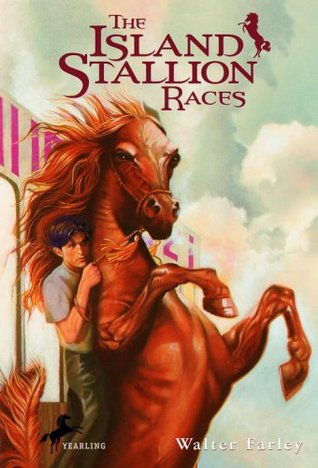 Book Name: The Island Stallion Races Author: Walter Farley First Published: 1955 Walter Farley was born in 1915 in Syracuse, New York. His uncle was a professional horseman and took the young Walter under his wing. He taught him about horses and training methods that were used on the world racing tracks. Walter spent a great deal of time with his uncle at the Belmont Race Track and stables. Many of his future novels would be set in this racing complex. Farley was a high school student at Erasmus Hall High in Brooklyn when he began to write the first Black Stallion novel. As he continued his education at Columbia College, he completed and published The Black Stallion in 1941 when he was still an undergrad at the university. The book was a success and Farley was ready to write sequels, but World War II intervened. He was forced to set his stories about Alec Ramsey and the Black aside and instead worked for the US Army magazine Yank for the next five years. It would not be until the end of the war that Farley could return to his first love, writing about horses and the racing world. Altogether, Farley would write 21 novels about his beloved horses and would become renown as a young adult author. Farley and his wife Rosemary had four children whom they raised on a farm in Pennsylvania and later in a beach house in Florida. The love for horses was passed on to his children and in one, his son Steve, the love of writing. In 1989, Walter Farley was honored by the Library in Venice, Florida by the creation of the Walter Farley Literary Landmark in it’s children’s wing. Soon after, Farley died of cancer in 1989. He would not see the completion of the Young Black Stallion book or the start of production of the television series The Adventures of the Black Stallion. There was also a famous Francis Ford Coppola film The Black Stallion, which features some of the most beautiful cinematography featuring an Arabian steed, a beach and a boy taming the heart of a horse. It stars Mickey Rooney as the old trainer and is well worth looking into as a family-friendly film everyone can love. “His mane was like a crest, mounting, then falling low. His neck was long and slender, and arched to the small, savagely beautiful head. The head was that of the wildest of all wild creatures- a stallion born wild- and it was beautiful, savage, splendid. A stallion with a wonderful physical perfection that matched his savage, ruthless spirit.” ― Walter Farley The Island Stallion Races is an unusual offering by Walter Farley, his only science fiction novel. The story returns us to Azul Island, a tropical paradise with a hidden secret: Inside the ancient walls of this extinct volcano is tucked away in the last outpost of the Spanish conquistadors where the descendants of their powerful steeds still roam. Young Steve Duncan and his scholarly friend Pitch have discovered the secret of Azul Island and Steve has befriended the mighty stallion Flame who guards his herd and keeps them safe. Pitch is called away while the pair study the ruins left by the Spaniards on the island and Steve is delighted to have more time with his favorite horse, a fire red steed that he longs to race so he can show off Flame’s speed and grace to the world. Alas, it is not to be. Flame has no pedigree or papers. He is barred from racetracks due to this defect. Enter a pair of supposed “Eastern American Business Men” who are anything but. Jay and Flick arrive on the island via unconventional means: An intergalactic spaceship. They have unusual talents such as transforming into birds when they wish. Their mission is to watch over the invisible spaceship that has been parked on the remote island while their colleagues Victor and Julian are off studying human culture. Jay would like to do more than simply study humanity. He has watched the beautiful horses of Azul Island for a long time and is interested in experiencing horse racing for himself. He concocts a plan to take Flame and Steve to Havana, Cuba via their invisible spaceship and enter the Island Stallion in the Grand International horse race. Does the Island stallion have what it takes to beat the best race horses on the planet? Will Steve overcome his fear of the aliens in order to pursue his dream of being Flame’s rider in a major racing event? Will Jay the intergalactic alien get away with his reckless behavior or will his comrades leave him behind when it is time for them to depart Earth? You’ll have to read the adventure to find out. One of my favorite series, when I was a pre-teen were the Black Stallion novels by Walter Farley. I had quite the crush on young Alec Ramsey and identified with his love of horses since I had a similar love for my own horse at that age. The Black Stallion novels are quite famous. The series is being continued by Farley’s son Steve Farley to this day. There is a second series of books written by Farley featuring another mighty horse. There are only five novels in the series about Flame the Island Stallion and his rider, Steve Duncan. Each one a well written YA adventure featuring a beautiful steed and the boy who loves him. Although the Island Stallion books were written at the same time as the Black Stallion books, I put off reading them. I loved the Black and Alec so much, I felt a sense of youthful disloyalty to read about this other horse. Much to my surprise, when I finally gave in to my curiosity, I found that I enjoyed these books as much, if not more than the original Black Stallion books. Azul Island, a walled paradise tucked away in the tropics and home to the beautiful equine descendants of the conquistador warhorses tickled my fancy with delight. Then, there was a second easter egg. The Island Stallion Races featured aliens from another world and their nefarious mission: horseracing! To my disappointment, the author never continued his science fiction ideas and this single offering is his only sci-fi novel. The storyline was enough to make this particular Walter Farley book one of my favorites. (Sorry Alec) I would love to see the Island Stallion stories made into movies as the Black Stallion books were. The stories are every bit as compelling as the more famous works by Walter Farley. If you are looking for science fiction in an unexpected place, give The Island Stallion Races a try. It is a family-friendly book that will make you and your horse-loving child smile. The Island Stallion Series: The Island Stallion (1948) The Island Stallion’s Fury (1951) The Island Stallion Races (1955) The Black Stallion and Flame (1960) The Black Stallion Challenged (1964)
The February round of Three Prompts is open! The December results will be announced soon.
A cNote shop with a fantastical theme. Profits go to the FSFS!
An FSFS-only forum to discuss writing mechanics.
The FSFS Review Board is open! All WdC members can view the list on the group homepage, "Fantasy and Science Fiction Society" . FSFS Members can view the list from the homepage, Review Board page and the Hub. To post on the board you need to review at least one other item on the list.
If you are not already a member and are interested in fantasy and science fiction writing, please read through the group homepage and apply using the application form. The only pre-requisite is that you have a fantasy or science fiction item in your portfolio. If you want to advertise in the FSFS Newsletter please contact me, Matt Bird MSci (Hons) AMRSC   . .Win! What are your writing resolutions for 2017? Let me know in the comments below. The best comment will win an FSFS Merit Badge. If there are more than 5 responses, then a random commenter will also win! Thank you to all the members who submitted articles to the Newsletter. If you submitted an article that wasn't included, don't be offended. I can only fit so much in the Newsletter. Please submit it again when I send the call out for articles. Please comment on this Newsletter if you enjoyed it, or if you have any suggestions for future editions. |
 un:
un:  View Portfolio
 Visit Notebook
 Send Gift Points
 Awards
 Badges



 Community Feed
 Puzzle Hub
 General Discussion
 Sponsored Items
 Book of Trinkets
 Static Items
 Books
Books Groups
 Interactive Stories
 Audio
Audio Campfire Creatives
 Community Notes
 Crossword Puzzles
 Documents
 Folders
 Images
 In & Outs
 Madlibs
 Photo Albums
 Polls
Polls Product Reviews
 Quizzes
 Survey Forms
 Web Pages
 Word Searches