%%USERNAME%%    %%ACCWORDS%% %%ONOFF%% |


 The FSFS Newsletter is written by FSFS members covering everything Fantasy and Sci-Fi |
The "Fantasy and Science Fiction Society" welcomes you to  Welcome to the December edition of the FSFS Newsletter, brought to you by the members of the "Fantasy and Science Fiction Society" . Each month the newsletter will feature artists from members at all stages of their writing career, be they just starting to write stories, or published authors. Contents 1. Month Summary 2. An Inside Look at NaNoWriMo 3. How to Research Your Novel 4. Being a Guest & Vendor at a Con - Day 1 5. The Interview - Part 1 6. Behind the Scenes - Time (and life) Savers 7. Book Review - City 8. Book Review - King Solomon's Mines 9. Advertisements 10. Newsletter Challenges 11. Three Prompts Winners  December is the month of festivity. Whether you celebrate Christmas or not, it is impossible not to notice that it's here. It seems that shops start putting their Christmas sales on earlier and earlier each year and that seasonal songs blast out from every possible sound source! For me Christmas is all about getting presents all about celebrating the joys of family, having a laugh with friends, eating good food in great company and getting together to watch a bit of Christmas telly (*fan-girl squeal*Doctor Who*fan-girl squeal*). We may enjoy receiving gifts, but there is always something special watching someone's eyes light up when they unwrap your gift and it is ... perfect. Of course there is also much fun to be had watching other people try to feign pleasure when they unwrap a pair of ugly socks  This is the FSFS's first ever Christmas, and to celebrate we've been hosting the "Invalid Item" . To date we have sold over 300 tickets and given away 23 fantastic sets of prizes. Now, I must apologise for not decorating the group like I traditionally did with the CSFS. I'm in my second year of university and this is the time of year where I start properly getting into revision for January exams, so the décor took a back seat, I'm afraid. I hope you all have a fantastic Christmas and wish you well for 2015. “Write a complete novel in thirty days? Yeah Right! No Way!” That was my reaction on my initial introduction to National Novel Writing Month almost twelve years ago. A friend said, “I can’t do (whatever it was) until December first. I’m doing National Novel Writing Month all through November.” “Are you crazy?” I asked. “I could never do that!” At that point in time my childhood dreams of writing novels (and yes, I did dream of being a writer as a child!) were just that – poorly formed, unreachable, mist-laden dreams. Three years later, on October 30th 2005, a fellow member of the online Lovers of Science Fiction and Fantasy writers’ group issued a challenge to each of us to participate in National Novel Writing Month. To this day I have no idea why I took up that challenge. I didn’t think about it, I just said yes, and publicly posted my acceptance of the challenge (so I’d be too embarrassed to back out later!). That decision stands as one of the best things I ever did for my writing! With only two days to plan I lay down the bare, dried out bones of a science fiction novel based on a short story I’d written several weeks earlier for another writing challenge. Fingers trembling on November first I wrote the prologue, {entry: 441269}. I stopped and stared at my computer screen. WOW! I’d started a brand new novel – a novel I had not even envisioned three days earlier! That November I finished my very first novel, and won NaNo for the first time, despite having my computer die the day after Thanksgiving when I was still 3,500 shy of the 50,000 word goal, having to e-mail myself all of my files to keep from losing them (that computer would not save to floppy disks anymore), and then going out buying a new computer setting it up, and reloading all of the files, before I could get back to writing. End the end? What an amazing experience! I had accomplished something I’d dreamed of and thought about for more than twenty years – and never made any headway with – within a mere thirty days. I was hooked for life! Fast forward to now . . . This year was my ninth year participating in National Novel Writing Month. And yes, it was just as exciting, harrowing, nerve-wracking and downright fun as it was the first time . . . Actually it was more fun. Why? Well, I didn’t have to go out and buy a new computer!  No, it was, because I learned to get involved with all of the aspects of National Novel Writing Month beyond just writing my novel. Here are just a few of the fun firsts I experienced during NaNoWriMo this year. No, it was, because I learned to get involved with all of the aspects of National Novel Writing Month beyond just writing my novel. Here are just a few of the fun firsts I experienced during NaNoWriMo this year.  For the first time ever, I sat wide awake, primed and ready to rock, when the clock struck 12:01 a.m. November first. At 12:02 a.m. my fingers hit the keyboard, and I was off and running with book two of last year’s tale. For the first time ever, I participated in the "October Novel Prep Challenge" here on Writing.Com. This was an ocean more planning and preparation than I’ve ever done in eight previous years of doing NaNo, and overall it provided great results, two in particular. One, it primed me for intense daily writing. By the time November first rolled around I’d worked out the most obvious kinks in my schedule and rolled into November already in the habit of a lot more writing than I normally do throughout the rest of the year. Two, the NaNoPrep assignments plunged me deeper into the world I’ve been creating over the years for my novels. As a result I developed a detailed map and geographical picture of the “Nine Counties”, as well as some government and religious guidelines, and a calendar, time-keeping system, seasons and a complete year’s worth of holidays. I also developed several detailed backgrounds and histories for more than my two main ch For the first time ever, I sat wide awake, primed and ready to rock, when the clock struck 12:01 a.m. November first. At 12:02 a.m. my fingers hit the keyboard, and I was off and running with book two of last year’s tale. For the first time ever, I participated in the "October Novel Prep Challenge" here on Writing.Com. This was an ocean more planning and preparation than I’ve ever done in eight previous years of doing NaNo, and overall it provided great results, two in particular. One, it primed me for intense daily writing. By the time November first rolled around I’d worked out the most obvious kinks in my schedule and rolled into November already in the habit of a lot more writing than I normally do throughout the rest of the year. Two, the NaNoPrep assignments plunged me deeper into the world I’ve been creating over the years for my novels. As a result I developed a detailed map and geographical picture of the “Nine Counties”, as well as some government and religious guidelines, and a calendar, time-keeping system, seasons and a complete year’s worth of holidays. I also developed several detailed backgrounds and histories for more than my two main characters. As I did those assignments I had worried that I’d get too bogged down in the planning and outlining I’d done and lose the spontaneity of my story when it came to actually writing the story. And at first I did a little as I tried to force the story and the characters into my now detailed outline. That faded into the mist, and instead, much of the pre-planning I’d done spring boarded into surprising new plots and even two new “created on the spot” support characters for the tale. Of course, I met lots of new writers for the first time – several doing NaNo for their first time ever – at the Write-Ins I attended. For the first time ever, in my region we had the privilege of holding weekly Write-Ins at a coffee house geared to Writers, Writing, and Books. Invalid Photo #1037795 Invalid Photo #1037794 Invalid Photo #1037796 What a huge change from the indifferent attitudes of the handy national chains of coffee house where we most often meet. The Ink & Bean folks welcomed us to their wonderful outdoor venue with open arms and went out of their way to make our group feel important and wanted. In fact they will be hosting a new, year-around writers’ group partly because of the participation of our WriMos this year. Now that is a HUGE first time ever! “NaNo” is always fun and amazing and filled with all sorts of challenges that interfere with our writing from job schedules to family emergencies to illnesses to broken-down vehicles to aching fingers and backsides and too many more to mention! Those challenges seem to always strengthen us and our resolve to plow on and make it to the end. And yes, there is always WINNING! Winning NaNo is delightful and a huge source of pride and accomplishment. But there is so much more to participating in NaNoWriMo than just making that word count goal. For me, National Writing Novel Month has become the number one motivator for getting me to work on and finish my novels. Once I start a novel in November I get super excited about it. That excitement stays with me throughout the year and makes it much easier for me to expand my fledgling tale, to proof it, and edit it, and re-write it throughout the year. You may be asking, “But what really makes this wild and wacky experience such a valuable writing tool?” First and foremost it is accomplishing the simple, but yet unbelievably difficult, task of making your writing the number one priority in your life for thirty days No Matter What! I can’t tell you how many times people have said to me “I can’t write a novel in thirty days. I work full time. I have a family to take care of. I have health issues. I don’t know what to write. I don’t have a good computer,” and so on and so forth. My answer to them: “Yes you can. If you really want to, you can do it! You can make your writing number one! You can write a novel in thirty days!” It is a matter of choosing to use every little snippet of time you have free to write. Instead of watching television for an hour, write 500 words. Instead of going to a movie, go to a Write-In, meet up with other writers, and write 1,000 words. Instead of lying in bed late on a Sunday morning get up and write 2,000 words. You have the choice. You decide how you use your time and energy. Make your writing your number one priority, and then act on it. NaNoWriMo is the tool you will use to be accountable not only to yourself but also to a worldwide group of writers doing the exact same thing. Knowing others are not just looking over your shoulder, but rooting you on is a powerful motivator to keep your writing your number one priority, even when it seems everything and everyone else in the world is fighting against you. “Everyone” isn’t fighting you. All of your fellow WriMos are supporting you and cheering you on. They know you can do it, because they are doing it too. In the end, it is the experience of doing National Novel Writing Month that will be your greatest gift, beyond the completion of your novel. If you step out and get involved with other “WriMo’s” you make new friends and begin to develop a steady group of fellow writers who not only encourage and support you through the month of November, but who also travel forward with you in exploring, expanding and developing your novel and your writing alongside throughout the entire year. In my region there are two active year-around writing groups that started from writers who first met at National Novel Writing Month Write-Ins. As I mentioned before, next year there will be a third meeting at the Ink and Bean Coffee Saloon. I can’t wait to see what 2015 will bring to our writing world and National Novel Writing Month. Maybe I’ll even see you there come next November! Invalid Photo #1037371 Invalid Photo #1037799 To learn more about NaNoWriMo Go To  http://www.nanowrimo.org/ http://www.nanowrimo.org/ Invalid Photo #1037794 To learn more about Ink & Bean Coffee Saloon Go To http://www.inkandbeancoffee.com/  There are many ways to go about doing research for a novel you're writing and the first question you need to ask yourself is, of course, "What type of novel am I writing?" This question will determine the type of research you'll need to do for your novel. You may wonder why it's important to do any research for your novel. The reason is because you want certain forms of reference to be known to you reader. Every novel has at least some things your reader must be familiar with, some items of truth which can be grasped by the reader. Even fantasy novels use known items of fairy tales to help the reader "adjust" to the author's way of thinking. Even if it's a completely new tale. As author's we want the reader to feel comfortable in what we're telling them. Let's begin with one of the most prolific genres on the market, Science Fiction. There are many types of Science Fiction novels out there. Some are modern era, i.e. 21st century and ones we easily understand terminologies and references to. Some are pre-modern era but we still understand the references and some are set in the future and/or space. These tend to have terms and references which sometimes need to be explained to the reader so they understand either the setting, culture, era or some other item which is not readily known to us in our time. So let's look at some items which can help us research and help us in writing a better Science Fiction novel/story. 1) Any book on space, planets, moons, etc. a. This type of book will help you with the concept of how objects in space react to other objects in space. I recently bought a National Geographic book on space. It has all of these items in one book, including information on the Kaipur Belt, Galaxies, Black Holes and more. 2) Any book on machinery a. If you're writing a book with robots or machines, this book will help you understand the capabilities and limits of machinery. It doesn't mean you can't stretch your imagination of what they can do. But it will help you understand the basics and where to begin. 3) Books on chemistry and any other science a. Depending on what you're writing about any science book, especially chemistry, will help you better understand where you want to go with your writing. Never underestimate the power of learning something from educational books. Now that we've delved deep into science let's look at another genre, Fantasy. This genre is also often mixed with Science Fiction into what's often dubbed as Sci-Fi/Fantasy. As you can imagine there are as many different types of Fantasy and Sci-Fi/Fantasy as there are imaginations in the world. It ranges from the classics of Tolkien to new novels of people like C.S. Friedman, Tad Williams, and Mercedes Lackey. There are thousands of different authors who vie for your attention when you go to a bookstore. But even if you're creating your own unique world there are still some rules you should follow, thus a bit of research needs to be done. Research for fantasy will be a bit different since it's more imaginative, but there can still be some technical aspects to it as well. So let's take a look... 1) With regards to world building a. You may still want to look at any book on space, planets & moons. With Fantasy it's not as restrictive as Science Fiction but if you're combining the two it becomes a bit more important. b. Do some research on our medieval history; depending upon what era you want your story to take place in either this time period or another may help you in discerning the type of clothes people wore and the type of culture was most prevalent. c. Books on machinery or war implements (i.e. swords, daggers, bows). I've come to find out myself there's a certain element of science in the use of any weapon. Knowing how they were made and used properly can help in your writing. 2) With regards to Character building a. There are many different types of characters in Fantasy. You have humanoid and non-humanoid. The first, of course, is easy; the second, not so much. What I suggest is to research your non-humanoid characters by reading either mythology books or, if they're a new type of non-humanoid character, read up on the animal which is closely related to that character. Find out how that character would move, sleep, eat and anything else. If it's a talking bear as in "The Golden Compass" read about bears. The more real you can make these non-humanoid characters in your novel the more believable they'll be for your reader. Now let's take a brief look at fiction which covers several genres. These books are ones in which the authors still use their imaginations to create a book but often still use real places and sometimes events with their characters. With this in mind I'm sure you can guess what needs to be researched when writing fiction. 1) Travel guides and maps a. These little gems can help you look up places you might want your characters to visit as well as points of interest within those places. 2) History books and newspapers a. History books and newspapers from all over the world will tell you what events have happened and when. They can be a great reference source. The last genre we'll be looking at now is Non-Fiction. These books are usually things like biographies, history books, essays of facts, How-to books, etc. These are probably the most researched books of all because every detail needs to be accurate. Depending upon what type of book you're writing depends upon what type of research you'd do and from where you'd get the information. 1) Biographies a. Information for biographies can be gained from family members, photographs, and letters from family members, genealogies, history books, and even newspapers (as well as your own memory). 2) History Books a. Information for history books can be gained from newspapers, eye witness accounts, interviews, and other history books 3) How-to-Books a. Information for How-to-Books can be gained from your own knowledge and knowledge of experts in the field In closing, remember every novel needs some type of research to help it become a great novel. As authors we have great imaginations and can create whatever we want but that creation needs a solid foundation so our readers can have a better grasp of understanding of our creations. "Invalid Item" by A Guest Visitor  I'm a guest at the first Chessiecon, which formerly was Darkovercon, in Maryland, which had been held for more than thirty-five years. Tamora Pierce, with over thirty books in print, is the Guest of Honor. What's good and bad is that I'm on a whopping seven panels this weekend, three of which are back to back, followed by my doing a reading, while, for the first time, also being a vendor. With the limited hours for selling books on the first evening of the con, it doesn't appear I have a chance to get to the Dealer's Room, but will definitely be seen on all those panels. I once asked an author at Darkovercon at what point was it worth investing the time and energy in having a booth. She said, "You need to have at least four books." At the time, of the four books in her series, she's sold out of books one and two. I doubt I'll do as well, but I definitely need the experience. Based on my schedule, though, I won't get a chance to sit at my table. The hours for the vendor room today are the shortest and I'm on panels or have my reading during all of them. Well, I figure, at least those here at the con will get to see me first as an author at all those panels. I guess a highlight of the panel this first day was: "The Appeal of Dystopian Young Adult Fiction" with Danielle Ackley-McPhail, Vonnie Winslow Crist, and Mary Fan. Introducing myself, I shared that I've watched my teenage daughter reading it all, Hunger Games and Divergent, among them, multiple times, and discussed what worried me with her getting so into the Hunger Games - and the movies. You see, my daughter at this age is a bit squeamish. But she can't get enough of Hunger Games. I've discussed the series with her and asked, but what about all the fact there's so much violence against kids. She looked at me and said, "Dad, the story's a romance." My fellow panelists shared that the appeal is vicarious. Danielle Ackley-McPhail offered that life for teens was a lot different over a hundred years ago. Death was a stark reality, not-so-much, anymore. Kids died on wagon trains, from illnesses and starvation, which, although, tragic school shootings occur, they are not the normal Dystopian Young Adult Fiction has changed a lot in recent years, it was pointed out, but there's an appeal of the "orphan," the kid, who has no adult mentor or parental authority to back them up, Vonnie Winslow Crist explained. The kid who also does not want to be a hero, but volunteers themselves for the greater cause, as author, Mary Fan, put it, is also the hook. She added, you'll also notice that the hero isn't the football captain or head cheerleader. Danielle went on, "There's an element of wish fulfillment." The outsider, the kid, who is a little different and doesn't feel accepted is who the readers relate to. In other words, "us," the author and reader Geeks are battling the dragons and are victorious, mostly. After all, this is dystopic fiction we're talking about. Two sessions and my reading later, I'm terribly hungry. The Dealer's Room is closed and... the hotel restaurant is slower than slow and after 45 minutes (never bringing my salad) brings me what I didn't order (a dinner salad). Hmm, it was a much cheaper meal, especially when the waiter apologizes, offering to re-order it. I can have it in about 45 minutes... Perhaps, things will be better tomorrow. I'm only on two panels. "Being a Guest & Vendor at a Con - Day 1" by Highmage - D.H. Aire   The following is an interview I did for matab15 to put in the second Science Fiction and Fantasy newsletter (December, 2014). Matt opened the questioning floor to all members of the Writing.com community. These are the questions I received and my answers. Most are to do with my job as an acquisitions editor for BookFish Books LLC., and the rest are about my personal writing. [Note from the Editor] There were so many questions asked last month and Kat answered them all so brilliantly that there simply isn't room to put them all in one Newsletter. For that reason you're getting the first 8 Q&As this month, and the other 8 next month! If you didn't read last month's issue, then check it out ("November 2014" ) and read Kat's article to better understand some parts of this interview. 1. What inspired you to write? I have always been a reader. As a kid, I consumed books at an alarming rate. Over time, I became quite opinionated about what I read, and developed my own ideas about what was "good." I fell into writing naturally--I came up with a story idea that I thought would be better than what I'd read, and began to put it on paper. If I recall correctly, my first completed manuscript was a historical romance, and absolutely the most horrifically written piece of drivel ever created (on foolscap, with a pencil). Still, the seed had been planted. I completed that manuscript when I was eleven years of age, and have never stopped trying to top it. And I still write with pencil. 2. How did you become an acquisitions editor with this small press? This is a question I ask myself every day--it's a dream come true for me. I am quite active in my local writing community. I am a workshop, writing group, and conference frequenter--have been for years. I've had some luck with publishing over the past few years, having sold eight pieces of short fiction, four poems, one novel (and another that will release this spring) and was commissioned to pen the narrative portion of an online roleplaying game. The house I published my first novel with has a closed forum for their signed authors. Publishing a book is exciting--everyone in that forum is enthusiastic and friendly, always helping one another to promote their work, and lending advice and so forth. One day, I started a thread in the author's forum to connect further with the people whom I thought might one day become my freelance clients. Coincidently, a fellow author was there who had a good friend that owned a small press, and was in dire need of a new copy editor. Unbeknownst to me, the author told the publisher, and then the publisher contacted me via my editing website. A few days later, I did my interview, and the rest is history. 3. Can anyone become an acquisitions editor, or do they need specialized training? Becoming a certified editor is an intense course of study at the university level, and the current editor is constantly participating in specialized workshops to keep their skills current. Our language is ever evolving, and it is important that an editor remains in the loop with popular trends. I went to university for substantive, stylistic, and copy editing. Acquisitions editing is covered in these courses to a degree, but the Editors' Association of Canada offers specialized training. There are frequent workshops for EAC members who want to update their skills in various kinds of editing. Acquisitions is one of the areas that can be added on to any editor's education through their local EAC branch. It is an add-on, though. So, to answer your question, yes, acquisitions editing is a specialized field. 4. "Stories you want to sell shouldn't be accessible to the public. They should never be visible through your WdC account, your website, or anywhere else. It's usually acceptable to set WDC items to 'Registered Authors and Above,' but 'Group Only' or 'Private' is safer. The only people who should have access to these stories are reviewers." What is the reason for this? I don't think I was the one who said this, but it is true nonetheless. Here's why: Once a piece has been made available for the public to read, in publishing jargon, it is considered "published." Many literary magazines and publishers want to purchase first publication rights. So, if the piece is already published, you cannot sell the first publication rights--you no longer have these rights. You would be surprised by the number of great submissions we have to reject because the author has already posted the story on Wattpad or their personal blog or the like. While some places will accept previously published material, the vast majority will not. To be on the safe side, restrict your WdC pieces to a specific readership, and be very, very leery of putting them up on Wattpad, ReadWave and similar. This is a way to get past the technicalities, while still being able to get peer reviews. 5. You mentioned the desire to produce "excellent books" and "books that sell well." What percentage of books are rejected based on marketability? At its core, publishing is all about making money, and making money is all about marketability. Sure, there is much to be said for the art of literature, but books need to "earn their keep." A manuscript will not be acquired if a house does not believe in its potential to appeal to the masses, and earn back the money that was spent producing it. That's business. Consider the number of people that must be paid with the sale of each book. At the minimum, there are the following: the author, the author's agent, the acquisitions editor, the substantive editor, the stylistic editor, the copy editor, the proofreader, the design manager, and the cover artist. If a book is retailing for $10, I'm sure you can see how that breakdown is not conducive to paying anyone's mortgage when sales are poor. I'ma go out on a limb here, and say that 100% of the manuscripts that are rejected are rejected because the acquisitions editor did not believe the finished product would be marketable. (Poor writing, clichéd or overdone plot, dull or impersonal characters--all these things will effect a book's marketability and doom it to failure. If a book sucks, people won't buy it. Thems the breaks.) 6. Kat, why did you go and contradict yourself and become an editor after openly claiming not to care about things like punctuation and grammar? (I think you know the person who asked that one rather well! [sic. this is a question I asked myself]) Ah, an excellent question. Basically, I lied. I DO care about such things. Very, very much indeed. 7. When you write, what is your writing process? Personally, I am a "pantser." I often come up with an opening sentence that I think is great, and after giving it some time to "simmer," the rest of the story simply falls out. I write feverishly. It is rare that the first draft of a novel will take me longer than two months to complete, even though I tend to edit as I go. I will write a short story in an evening. Mind you, the stories are not always good. However, that is my process. (In short, I have none.) 8. What part of your job is the hardest, and what part do you enjoy the most? The hardest part for me, by far, is having to reject great stories. Sometimes, the timing is just not right. Sometimes, a great story comes in, but we already have a story with the same theme on the docket set to release within the next year. Sometimes, I will opt to take on a manuscript, and in the editorial meeting, my colleagues will vote against it (or vice versa). This happened recently to a manuscript I absolutely LOVED, but unfortunately, we already had a story in the same genre set to release, so the rest of the team vetoed it. We are a small house and can only take on a small number of titles per year. If we put out more than one book in the same genre, it may push away our readers who like to read books of a different sort. The best part of my job is winning an author over. Fiction writers are freakishly protective about their words, and are often very skeptical about having an editor tamper with them. The last book I did, the author needed to know the reasons behind EVERY SINGLE suggestion I made (yes, this included minor things like comma placement). While this may seem annoying, I enjoyed it. This constant grilling gave me the opportunity to explain the rules, dissect the sentence with her, and gain her full trust. While, at the outset of our work together, this author was a bit abrasive, by the end of it, she was asking me to look over her unrelated work on a freelance basis. That makes me feel great--like I'm worth my salt, even to an author who really didn't think so at the beginning of the project.  Each month I write an article taking you behind the scenes of the FSFS. This month I'd like to share some of the tools I use both on and off WdC to make running the group just a little bit easier. The {insert:1234567} WritingML When you have a group with loads of different forums, contests, newsletters, activities, pages, etc... it is important to have an easy to navigate site. The trouble comes when you want to update the navigation menus. You have to edit each and every page where that menu appears. For the FSFS that would require editing seven pages! Writing ML to the rescue! Back in May of 2012 I was faced with this exact problem. So I went over to the "Suggestion Box" and created a suggestion ("Insert Text" ). Guess what? The StoryMaster  had already created a piece of WritingML for this very purpose, but it was only for use with system items that SM created. He unlocked it for everyone to use and it has since saved me hours upon hours of time. had already created a piece of WritingML for this very purpose, but it was only for use with system items that SM created. He unlocked it for everyone to use and it has since saved me hours upon hours of time.Now, I only have to edit one item ("FSFS Navigation" ) and I'm sorted. Whenever I want the FSFS navigation menu I simply have to put the code {insert:2016891} and it's there! I use it at the bottom of this very newsletter, in fact! I also use the code for the Review Request Page. As the list of review requests appears on the home page, the Hub and the request page I made a separate item to list the requests on. Simples! Smart Quote Replacer Sometimes, on WdC smart curly quotes don't show up properly. The issue is fixed in some places, but not others, so to be safe I switch out every set of quote marks in submissions for the Newsletter. This used to take a while. Until I found Dan Hersam's tool which switches them all out for me! [Edit] The StoryMaster  has reviewed this article and informs me that the Smart Quotes should work now. I haven't tested this as I put everything through the tool, but will report back when I run tests in the future. Still, the tool was a massive time saver when it was an issue! has reviewed this article and informs me that the Smart Quotes should work now. I haven't tested this as I put everything through the tool, but will report back when I run tests in the future. Still, the tool was a massive time saver when it was an issue!The list WritingML I mentioned at the start of the newsletter that the Advent Raffle has sold over 300 tickets. Not so long ago that would have required me to write out the number for each and every ticket. Not so bad when someone buys one ticket, but when someone buys 40 tickets for different people it can be a tad repetitive and time-consuming. Worse is when you miss a number accidentally and then it wins! Worse still is when you double up a number and it wins! I've seen both happen. With one of the more complex bits of writingML, that is a thing of the past. When I create a list of raffle tickets all I have to do is write this bit of code: {list:raffle:Ticket #%}Matt Dan Kat{/list} Then I put in the ticket holders between the two tags, and WdC does it all for me like so: Ticket #1 Matt Ticket #2 Dan Ticket #3 Kat STV Calculator Running a contest fairly is of paramount concern to anyone who creates a contest. The problem is always deciding how to decide the winner. Some contests use judges which score each entry and the total decides the placings. I like contests where the public decide the winner. I like this method for two reasons A) I don't need to arrange judges and chase people, B) It gets everyone involved. But how do they pick their favourites? I could have a survey with one question on it asking for their favourite item. The trouble with that is in deciding second and third place. What if everyone votes the same item? So I allow you to pick your top 3. But if 40% pick their favourite as A, 25% as B, and 35% as C, does that make A the winner? Well, no. Because over 50% don't agree. So, I need to go to second favourites and take those into account. But how to weight those secondary and tertiary votes? Anyway, once one item gets over 50% it can be declared a winner and the process repeats for second and third place. But this is fairly involved and complicated and I don't want to mess it up. So I turn to Paul Lockett's tool . I put in the variables, then put in the votes. What I like about this calculator over others is that, like a good student, it shows its workings. This is important as it randomly chooses if it all ends in a tie. I need to know if it has ended in a tie so that I cast the tie-breaker, not a randomiser. Excel Ah, the good old Microsoft Office suite. I use Word for short stories, PowerPoint for video creation, and Excel for keeping tabs on everything. Running a group requires good organisational skills. Trouble is, I don't have fantastic organisational skills. In the CSFS I would forget newsletter submissions, mislay results and lose important numbers. For the FSFS I made a spreadsheet and those problems have mostly gone away. When a newsletter submission comes in, I add it to the Newsletter tab, when a prize donation comes in it goes on the Raffle Prizes tab, when I'm done with a voting round, I archive the results on the Results tab. I have tabs for keeping notes of important numbers and lists. Without Excel this Newsletter would be half as long and two days late! "Invalid Item" by A Guest Visitor } Book Review - City by chord0 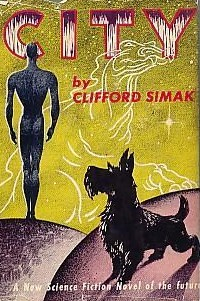 By Georgina H. Brandt Cuba (1958- ) Word count: 746. City is an apocalyptic novel, in which the world ends "not with a bang, but with a whisper." Reminiscent of Asimov's I, robot, City is a collection of short stories loosely interrelated written after World War II. It portrays a decadent peaceful almost pastoral world, in which Mankind evolutionates towards its own extinction, replaced first by Dogs and then Ants. The novel, or rather the first story City, begins with Simak's version of the aftermath of WWII. After the atomic bomb scare, Mankind has abandoned the cities and secluded themselves in hydroponic farms leading a pastoral self-sufficient life. Without the existence of cities, families have become isolated, each in their farm, where everything is available at the touch of a button (internet). The second story, Huddling Place follows by expounding on the idea of Mankind's isolation as portrayed by the Webster family and its robot serf Jenkins. As in Asimov's I, robot, Jenkins has two main purposes: he serves as the servant of the Webster family, as well as, a machine or computer that keeps all the family's historical records, somewhat like Star War's R2D2. Agoraphobia, the fear of the outdoors and unfamiliar places has taken hold of Mankind; as a result, of his escape from the cities and his own destructive impulses. In Census, Jerome Webster's grandson operates on Dogs and gives them the power of speech and better eyesight. In an effort to push Mankind further into evolution, Jerome gives these physical talents to Dogs because Two brains are better than one". This propels Mankind further into its own extinction, as it is replaced by the civilization of the Dogs. Reminiscent of Asimov's Foundation series, a mutant robot named Joe helps Mankind in his conquest of the stars by providing the technology of the rocket ship. In Desertion, Man succeeds in the conquest of Jupiter. Each man of the group and his dog, go out to gather data (in a transformed physical nature in order to adapt to Jupiter's atmosphere) and never come back. In Paradise, 5 years after Desertion, Fowler returns to his human form to tell Mankind about Jupiter's paradise. Tyler Webster interprets this news as a threat to Mankind's existence as humans. Joe gives humans telepathy, and this propels them to their domination of the Universe. In Hobbies, Jon Webster is one of the few remaining humans on Earth, after the majority has left to Jupiter. In desesperation to occupy his time, he takes on useless and meaningless hobbies. Jon pulls a switch that encapsulates Geneva, the last city in a protective shield that furthers Mankind's extinction. In Aesop, the robot serf, Jenkins is 7,000 years old, and is the overseer of the Dogs, and the few 'violent' humans whom he later takes to a parallel world in an attempt to preserve 'peace on Earth.' Unlike Asimov's Daniel-Oliwav, Jenkins is not an entirely loyal serf to the humans, and instead strives to preserve the civilization of the Dogs by facilitating the human conquest of the stars. In the Simple Way, Earth is now inhabited by the Beasts, watcher robots and ever more intelligent Ants, who are now able to reprogram robots to build their city. Jenkins revives Jon Webster from suspended animation, to learn the 'simple way' to kill the Ants, a poison sweetener. Of course, the Dogs would never agree to such 'mass killing', so Jenkins lets Nature take its course. In Epilog, all Beasts are now dead including Dogs and the Ant city has taken over the world. When the Ant city begins to crumble, Jenkins regresses to his original purpose and leaves to Jupiter to help in the survival of the few 'transformed' humans. All that remains on Earth of the 'glorious' human civilization is Jon Webster in suspended animation. From Wikipedia.org: "Many of his aliens have a dry, otherworldly sense of humor, and others are unintentionally amusing, either in their speech or their appearance. So too are his robots full of personality, and even his dogs. By contrast, his "heroes" are ciphers. His protagonists are often boring men, never described and never reappearing. They solve crises by muddling through, and if they fall in love with "the girl" (also never described), it's incidental." City was Simak's masterpiece and he received the National Fantasy award in 1953. This essay won a writing competition in redbubble.com (2008). Bibliography City, by Simak En.Wikipedia.org/wiki/Clifford D. Simak "Invalid Item" by A Guest Visitor  Book Name: King Solomon's Mines Author: Sir H. Rider Haggard First Published: 1885 Sir Henry Rider Haggard, better known as H. Rider Haggard, was born in Bradenham, Norfolk on June 22, 1856. He was the eighth of ten children and unlike his older brothers, he did not study in a private school, probably due to financial constraints and his father's low regard for him. In 1875, Haggard was sent to South Africa to do unpaid work. During this time, he fell in love with Mary Elizabeth "Lilly" Jackson and planned to marry her once he got paid work in the continent. When he became Registrar of the High Court in the Transvaal in 1878, he wrote to his father about his plan to return to England and marry Jackson. His father, however, would not allow him to return without having made a career first. By 1879, Jackson had married a rich banker and upon Haggard's return, he married Marianna Louisa Margitson. The couple went to Africa and had a son and three daughters. In 1882, the couple went back to England. Haggard became a lawyer but he spent a lot of time writing novels. To prove to his brother that he could write a good story like Treasure Island, he wrote King Solomon's Mines. The novel was written in 6-14 weeks but was rejected by publishers once it was finished. When it was finally published in September 1885, it quickly became a best seller. Haggard released a sequel, Allan Quatermain, shortly. The stories were influenced by adventurers he met in Africa and the wealth and ancient ruins in the continent. King Solomon's Mines is credited as the start of the Lost World genre, which influenced popular American pulp writers like Edgar Rice Burroughs and Robert E. Howard. The hero Allan Quatermain became the template for Indiana Jones and regained popularity as a major character in the League of Extraordinary Gentlemen. Haggard was also heavily involved in agricultural reform and was part of several commissions on land use and similar issues. In 1912, he was made a Knight Bachelor and in 1919, he became a Knight Commander of the Order of the British Empire. He died on May 14, 1925, when he was 68. "Truly wealth, which men spend all their lives in acquiring, is a valueless thing at the last." - H. Rider Haggard, King Solomon's Mines Allan Quatermain is an adventurer and professional hunter based in Durban, South Africa. Sir Henry Curtis and Captain Good ask him to help them find Sir Henry's brother, who is on a journey in the unexplored territory to find the mythical King Solomon's Mines. Quatermain possesses a map to the mines but has not really believed in its authenticity. Nevertheless, he agrees to join the two men if they will share the treasure they will find or financially support his son in case he dies during the trip. Quatermain does not believe that they will be able to return alive but thinks that his death will at least provide support for his child. The three men are accompanied by Umbopa, a mysterious native who seems more eloquent and regal than the other porters. They travel by oxcart until the edge of a desert, then begin walking. Fortunately for them, they discover an oasis along the way. They reach the Suliman Berg and climb one of the peaks of the mountain range. Inside a cave is the frozen corpse of José Silvestre, the explorer who drew the map using his blood. When another servant dies because of the freezing temperature, they leave the body to provide Silvestre a companion. They then reach a lush valley called Kukuanaland. They escape being killed by Kukuana warriors when Captain Good fidgets with his denture, which scares the warriors. From then on, they pretend to be powerful gods but they still have to regularly prove their claim, which stresses them and strains their creativity. They are then brought to King Twala, who killed the former king (his brother) then sent his brother's wife and son Ignosi to die in the desert. An old, evil witch named Gagool serves as the king's primary advisor and murders those who oppose her and the king. Umbopa earns Gagool's suspicion but Quatermain is able to save him. Soon, it is revealed that Umbopa is Ignosi, the true king of Kukuanaland. The Englishmen gain support by using the foreknowledge of a lunar eclipse to prove Ignosi's claim. Twala is overthrown by the rebels and loses his head in a duel with Sir Henry. Gagool reluctantly takes them to King Solomon's Mines but while the men are admiring the treasure, she sneaks out and uses a hidden mechanism to trap the men inside. With their food and water supply dwindling, the trapped men prepare for death. There is something about these Victorian era pulp novels that calls to me. The world was largely unexplored back then, magic and mystery abounded in places that we now call home. King Soloman's Mines was one of those break out novels for its author. It was a huge bestseller of its day, a "star wars" for the Victorians, and it still has much influence over our stories today. While a pure adventure tale and worth reading just for the sheer fun, it is not a shallow book at all. The characters are interesting and well developed and it has a few literary allusions to the Old Testament of the Bible and the Ingoldsby Legends. While the author does portray his protagonists as British imperialists, true to his culture of that time, there is more in his tale. His native Africans gradually emerge as fully developed individuals, capable of great nobility and wisdom, or evil. Quartermain himself undergoes a broadening of outlook during his adventure and he comes to see the people ar ound him as equals instead of natives that "should known their place". I feel that this helps keep King Solomon's Mines from becoming too dated for today's readers. You can find a free download of King Solomon's Mines on Project Gutenburg. Find yourself a copy and enjoy it on a hot summer day with a cold soda or beer while you experience the African of yesteryear. It is the first of a series of 15 novels, so if you like it, there is more to enjoy. Allan Quatermain Series: King Solomon's Mines (1885) Allan Quatermain (1887) Allan's Wife & Other Tales (1887) Maiwa's Revenge: or, The War of the Little Hand (1888) Marie (1912) Child of Storm (1913) The Holy Flower (1915) (first serialised in the Windsor Magazine December 1913-November 1914) The Ivory Child (1916) Finished (1917) The Ancient Allan (1920) She and Allan (1920) Heu-heu: or, The Monster (1924) The Treasure of the Lake (1926) Allan and the Ice-gods (1927) Hunter Quatermain's Story: The Uncollected Adventures of Allan Quatermain (collection, 2003)
Please vote for your favourite entries to the Christmas round of Three Prompts
The FSFS Review Board is open! All WdC members can view the list on the group homepage, "Fantasy and Science Fiction Society" (once review requests have been made). FSFS Members can view the list from the homepage, Review Board page and the Hub. To post on the board you need to review at least one other item on the list. This rule is wavered for the first 6 review requests!
Help raise funds for the FSFS and other worthy groups! Tickets are just 1K. Raffle ends Christmas Day!
If you are not already a member and are interested in fantasy and science fiction writing, please read through the group homepage and apply using the application form. The only pre-requisite is that you have a fantasy or science fiction item in your portfolio. If you want to advertise in the FSFS Newsletter please contact me, Matt Bird MSci (Hons) AMRSC  . .Newsletter Challenges  Each month I will publish two Newsletter Challenges for you to complete before the next Newsletter. If you complete a challenge you will be entered into a draw for the chance to win an FSFS Merit Badge. There are two challenges to complete. The first challenge can be completed by anybody. The second challenge can only be completed by FSFS members. FSFS members can complete both to get multiple entries into the draw. Invalid Merit Badge #201075 Last month loads of you answered questions, and loads of FSFS members fan'd the required items (I sent out a clarification email about that). I assigned you all numbers and randomly drew a number (using excel). The winner of the FSFS Merit Badge is ..... Dream ~★~ Justly This month's challenges are: Challenge 1 (open to all of WdC): In the advertisements I listed the vote for the Christmas round of Three Prompts. Everyone who votes will get an entry to the Challenges draw. "Invalid Item" Challenge 2 (FSFS members-only): I mentioned the "Review Board" . For every review affiliated to the FSFS you make of an item on the review board, you will get an entry to the Challenges draw. Keep checking the board as new items may be added between now and the next newsletter. Make sure link to your review in the comments section of this newsletter. Three Prompts Winners  With 5 great entries to chose from, you, the voting public, decided on your favourite. It is my pleasure to announce that in second place, and receiving a 25K awardicon is . . . . "Invalid Item" by A Guest Visitor And, in first place, winning the substantive or copy edit from https://movetothewrite.com of any writing under 2500 words, a 50K awardicon and an FSFS merit badge is . . . . "Invalid Item" by A Guest Visitor Congratulations. Your prizes will be with you tomorrow. KMH (editor at movetothewrite.com) is currently away, and may not get in contact with you straight the way. Use this time to decide what piece (2500 words or under) you want editing and whether you want a copy or substantive edit (details on the site). Thank you to all the members who submitted articles to the Newsletter. If you submitted an article that wasn't included, don't be offended. I can only fit so much in the Newsletter. Please submit it again when I send the call out for articles. Please comment on this Newsletter if you enjoyed it, or if you have any suggestions for future editions. |
 un:
un:  View Portfolio
 Visit Notebook
 Send Gift Points
 Awards
 Badges



 Community Feed
 Puzzle Hub
 General Discussion
 Sponsored Items
 Book of Trinkets
 Static Items
 Books
Books Groups
 Interactive Stories
 Audio
Audio Campfire Creatives
 Community Notes
 Crossword Puzzles
 Documents
 Folders
 Images
 In & Outs
 Madlibs
 Photo Albums
 Polls
Polls Product Reviews
 Quizzes
 Survey Forms
 Web Pages
 Word Searches